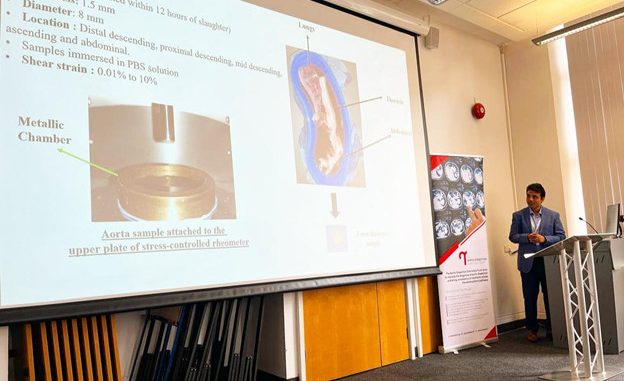
Oxford, UK — Dr Aadarsh Mishra, an Oxford University PhD graduate and Cardiff University alumnus, has published a new research paper in the Journal of the Mechanical Behavior of Biomedical Materials (Elsevier), further consolidating his work in kidney biomechanics, rheology, and tissue-mimicking biomaterials.
The publication builds on a strong body of previously reported research covered by Healthcare Newsdesk, News From Wales, and Southeast Online, and follows Dr Mishra’s recognition by The British Society for Nanomedicine (BSNM). Together, these works position him at the forefront of interdisciplinary research connecting engineering, medicine, and healthcare innovation.
A key motivation behind Dr Mishra’s work is the advancement of lithotripsy and elastography-based diagnostic techniques, including Magnetic Resonance Elastography (MRE) and Shear Wave Elastography (SWE). By developing tissue mimics that accurately reproduce kidney mechanics at clinically relevant length scales and frequencies, this research supports improved calibration, validation, and interpretation of non-invasive imaging methods used for early disease detection.
Academic and Research Background
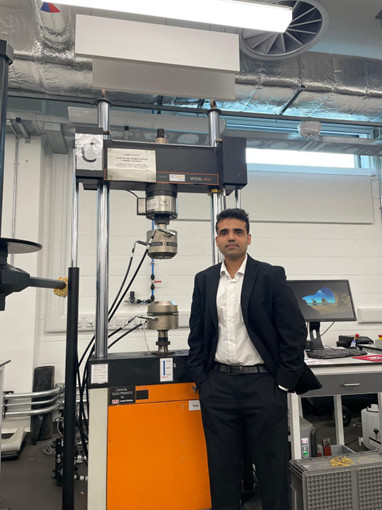
Dr Aadarsh Mishra pursued postdoctoral research at the University of Southampton and subsequently worked as a Senior Research Fellow in an aerospace manufacturing research programme, contributing to advanced finite-element modelling and materials characterisation.
His research focuses on the rheology and biomechanical modelling of agarose hydrogels and soft biological tissues, with the long-term goal of developing realistic tissue mimics for medical diagnostics, surgical training, and biomedical device testing.
Key Findings of the Elsevier Study
In the newly published study, Dr Mishra investigates kidney mechanics at the micro-length scale, a critical regime that governs tissue behaviour at cellular and sub-structural levels.
A central objective was to determine whether agarose, a commonly used biomaterial, could accurately replicate the mechanical behaviour of kidney tissue at small length scales. Using nanoindentation-based dynamic mechanical testing with a 100 μm diameter probe, Dr Mishra measured the shear storage modulus and loss modulus of both porcine kidney tissue and agarose gels across physiologically relevant frequencies (10–110 Hz). These results were then compared with conventional macro-scale rheological tests conducted at lower frequencies.
Key findings include:
- Kidney tissue exhibits markedly different mechanical behaviour at the micro-length scale compared to the macro-length scale, with storage modulus values between 1.2 and 70 times higher, depending on agarose concentration and tissue structure.
- An agarose concentration of 1.2% provides the closest mechanical match to porcine kidney tissue at the microscale, offering a quantitative, experimentally validated basis for selecting tissue-mimicking materials.
- A semi-fractional Kelvin–Voigt viscoelastic model more accurately captures time- and frequency-dependent tissue behaviour than conventional integer-order models, enabling reliable predictions under dynamic loading relevant to medical procedures.
These findings establish a multiscale mechanical framework for kidney tissue, linking micro- and macro-scale behaviour and providing guidance for designing realistic tissue phantoms.
Broader Applications
Dr Mishra’s work has the potential to significantly impact healthcare and medical research by enabling:
- Safer and more effective kidney stone treatments such as shock wave lithotripsy
- Improved diagnosis of chronic kidney diseases
- Realistic test environments for biomedical device development and validation
Academic and Professional Achievements
Dr Mishra completed his DPhil in Engineering Science at the University of Oxford, supported by the National Institutes of Health (NIH, USA), where he worked on “Passive Acoustic Mapping for Monitoring Burst Wave Lithotripsy”. He graduated with First Class Honours in Mechanical Engineering from Cardiff University.
His contributions include:
- Co-invented the electrode shield design at Alesi Surgical Ltd. (as an R&D Engineer) at the age of 19, later filed as an international patent
- Worked on a defence research project at IIT Delhi
- Completed a research internship in tribology at IISc Bangalore at the age of 17
- Co-authored a high-impact paper in Nano Letters at the age of 21
- Published a chapter in the book Power Ultrasonics
- Presented research at leading international conferences, including the Annual European Rheology Conference
In March 2024, Dr Mishra was recognised by The British Society for Nanomedicine for his contributions to soft tissue biomechanics and biomaterials. He was also elected a Fellow of the Royal Astronomical Society at the age of 19.
Dr. Aadarsh Mishra was awarded a Doctor of Philosophy (DPhil) from the University of Oxford in Engineering Sciences.
Dr Mishra on his research
“My long-term aim is to predict and minimise tissue damage during medical procedures. By combining biomechanics, rheology, and advanced modelling, we can design better diagnostic tools, improve surgical training, and support earlier, more personalised healthcare interventions.”
The paper is published in the Journal of the Mechanical Behavior of Biomedical Materials (Elsevier) and is available via the DOI: 10.1016/j.jmbbm.2026.107332.
Dr Mishra’s ongoing work continues to integrate biomechanics, biomaterials, nanomedicine, and artificial intelligence, highlighting the importance of interdisciplinary collaboration in shaping the future of healthcare.