Arthurian Legends cover the land between South Wales and Cornwall but many living within Bridgend, a town nestled in the scenic landscapes of Wales, are unaware that the holds a captivating mythical history that reportedly intertwines with the legendary tales of King Arthur and his Knights of the Round Table.
In fact, there is plenty to suggest that at least some of the real-life heroes behind the myths hail from Wales, not least because the first mention of Arthur is thought to be a reference in a line from the poem, ‘Y Gododdin’, the earliest known work of literature in Welsh. Merlyn (Myrddin) has long been associated with Carmarthen, and some of the legends did, according to some writers, take place in Bridgend and the surrounding areas and a major conference into the legend, concluded that if the mythical king ever existed, he was probably from Wales with strong links to Brittany, in northern France.
This article delves into the Arthurian connections within Bridgend, exploring the sites, stories, and references that have the potential to bring this mythical era to life in the local landscape.
1. Did King Arthur die in the region?
Alan Wilson, a Welsh authority on Arthur, believes that historical records from the life of St Illtyd, Arthur’s cousin who buried the monarch, show his body was taken up the Ewenny River and later placed in a cave near Pencoed following his death in 579AD.
2. Ogmore Castle: A Symbol of Arthurian Power
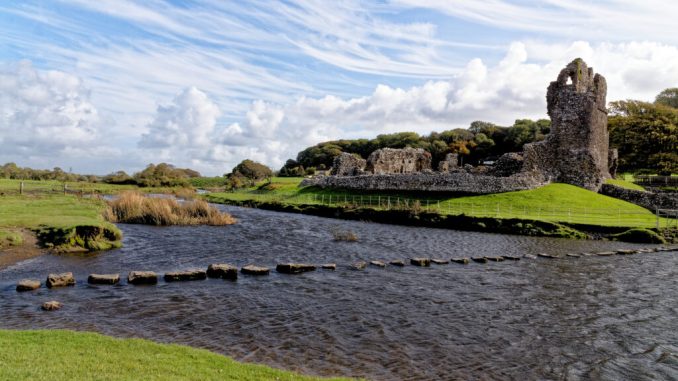
Ogmore Castle, situated on the banks of the River Ogmore, is a prominent landmark closely associated with Arthurian legends. The castle, believed to have been built by William de Londres in the 12th century, overlooks the stepping stones known as “The Ford of Barking.” According to legend, it was at this very ford that Arthur’s knights would prove their worth by battling demonic creatures known as the afanc. The castle’s imposing ruins serve as a reminder of the era’s chivalry and the epic tales that have shaped Bridgend’s folklore.
3. Newcastle Hill: The Mound of Arthur’s Sleeping Knights
Just a short distance from Bridgend lies Newcastle Hill, a grassy mound enveloped in mystery. Folklore claims that beneath this hill lies a sleeping army of knights, awaiting the call to rise and defend the realm. Some locals believe these slumbering warriors to be none other than King Arthur and his loyal Knights of the Round Table. This tale adds an air of mystique to Bridgend’s landscape and inspires the imagination of those who visit the site.
4. Llangynwyd Church: The Final Resting Place of Sir Gawain
Llangynwyd Church, a historical place of worship in Bridgend, is said to be the final resting place of Sir Gawain, one of King Arthur’s most renowned knights. According to legend, Sir Gawain’s tomb lies within the churchyard, and his spirit is said to wander the area. The connection between Llangynwyd Church and Arthurian legends offers visitors a tangible link to the iconic characters of the Arthurian tales, further deepening the town’s mythical appeal.
The Arthurian Trail: Discovering Bridgend’s Legendary Heritage
Bridgend offers an Arthurian Trail, a curated journey that allows visitors to explore the town’s rich Arthurian heritage. The trail encompasses various landmarks, including Ogmore Castle, Newcastle Hill, and Llangynwyd Church. Information boards and guided tours provide insight into the legends, their historical context, and their impact on Bridgend’s cultural fabric. The Arthurian Trail is a must for enthusiasts seeking to immerse themselves in the captivating tales of King Arthur and his knights.
Bridgend, a town steeped in myth and history, stands as a testament to the enduring legacy of Arthurian legends. Through its enchanting landmarks and tales passed down through generations, the town embraces its connection to the iconic characters of King Arthur’s realm. The presence of Ogmore Castle, Newcastle Hill, Llangynwyd Church, and the Arthurian Trail offers visitors a glimpse into a bygone era of knights, quests, and mythical creatures. Exploring Bridgend’s Arthurian heritage not only satisfies the curiosity of folklore enthusiasts but also provides a deeper understanding of the cultural roots that shape this captivating Welsh town.
References:
- Bridgend County Borough Council. (n.d.). Arthurian Legends. Retrieved from https://www.bridgend.gov.uk/services/arts-and-culture/bridgend-county-boroughs-arthurian-legends/
- Britain Express. (n.d.). Ogmore